





Introduction — Baptism and Power: the political story of Ravenna’s Two Baptisteries
Ravenna, a small port city in north-eastern Italy, is an open-air museum where Byzantine Christianity carved stone and painted glass. At the heart of this UNESCO World Heritage town sit two seemingly modest but exceptionally powerful buildings: the Battistero Neoniano (often called the Orthodox Baptistery) and the Battistero degli Ariani (the Arian Baptistery). Together they embody a tangled history where theology, liturgy and politics meet to assert, contest or reassert claims to authority. These baptisteries are not just sacramental spaces; they are visual and symbolic instruments of religious and civic control, staged by successive regimes — late Roman, Ostrogothic and Byzantine — that shaped Ravenna between the 5th and 6th centuries.
Baptism, the ritual that transforms a pagan into a Christian, was also an act of social and political integration. In Ravenna, the mosaics, inscriptions and spatial layout of the baptisteries stage power: who gets baptized, how they’re baptized, and under which rite. The Neoniano baptistery, with its dome dominated by a youthful Christ, celebrates an orthodoxy expressed through celestial images and sharp inscriptions. The Arian baptistery, quieter in some decorative aspects but rich in theological meaning, reveals the confessional tensions between supporters of Arius and adherents of the Nicene line. The very physical coexistence of these two buildings in the same city is itself a political statement — a key city, a crossroads of power where liturgy becomes a tool for dynastic and territorial legitimation.
Visiting these sites today is like reading a liturgical and political map carved in marble and tesserae. It means understanding that Ravenna’s mosaics are more than aesthetic marvels: they helped produce and maintain identities, promote alliances, erase rival narratives and display an official memory. This article offers an immersive, historically grounded and practical tour of the Two-Rite Baptisteries: detailed descriptions, addresses and opening hours to plan your visit, tips for photographing without harming the site, and an analytical dive into how these small monuments influenced the political and religious balances of their day. Whether you’re a curious traveler, a local guide or an art-history enthusiast, you’ll find the keys here to understand how a simple water ritual could weigh on sovereignty decisions and shape an entire city’s face.
Historical and political context: Ravenna between empires and heresies
In late antiquity (5th–6th centuries), Ravenna was no longer the imperial capital of ancient Rome but became a strategic administrative and military center. After the fall of the Western Roman Empire, Ravenna hosted the master of soldiers and governors, then served as the seat of Ostrogothic power before falling under Byzantine rule. This succession of rulers turned the city into an experiment in confessional politics. Baptisteries — small liturgical buildings dedicated to the sacrament of baptism — became silent but deliberately expressive witnesses to the power plays between religious factions and political authorities.
The two baptisteries at the center of our story were built at moments when the choice of rite and religious symbol expressed political alliances. The Battistero Neoniano (Orthodox Baptistery) is generally linked to the city’s elite who supported the Nicene doctrine; its ambitious decoration asserts continuity with Roman and Byzantine imperial tradition. The Battistero degli Ariani, by contrast, was associated with the Ostrogothic kings and their followers who adhered to Arianism, a Christological doctrine considered heretical by the Council of Nicaea (325). The existence of two rival baptisteries in one town is not mere folklore but reflects a deep division: baptism was not only religious initiation but an act of political allegiance.
Politically, controlling baptism meant controlling civic lineage, membership in the recognized community and access to public office. Rulers used images — Christ in majesty, scenes of the baptism of Christ by John, imperial inscriptions — as a political language. These visuals legitimized the patrons who commissioned the buildings and steered the population toward the version of Christianity they favored. So the simple choice of a mosaic motif or liturgical inscription can be read as a political manifesto, posted in gold and glass tesserae.
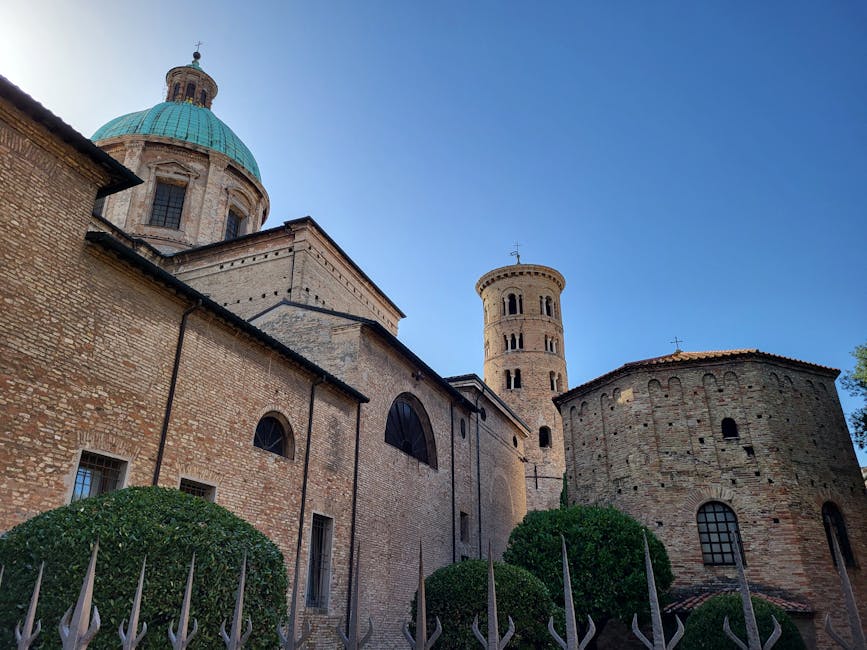
The Battistero Neoniano (Orthodox Baptistery): description, symbolism and power
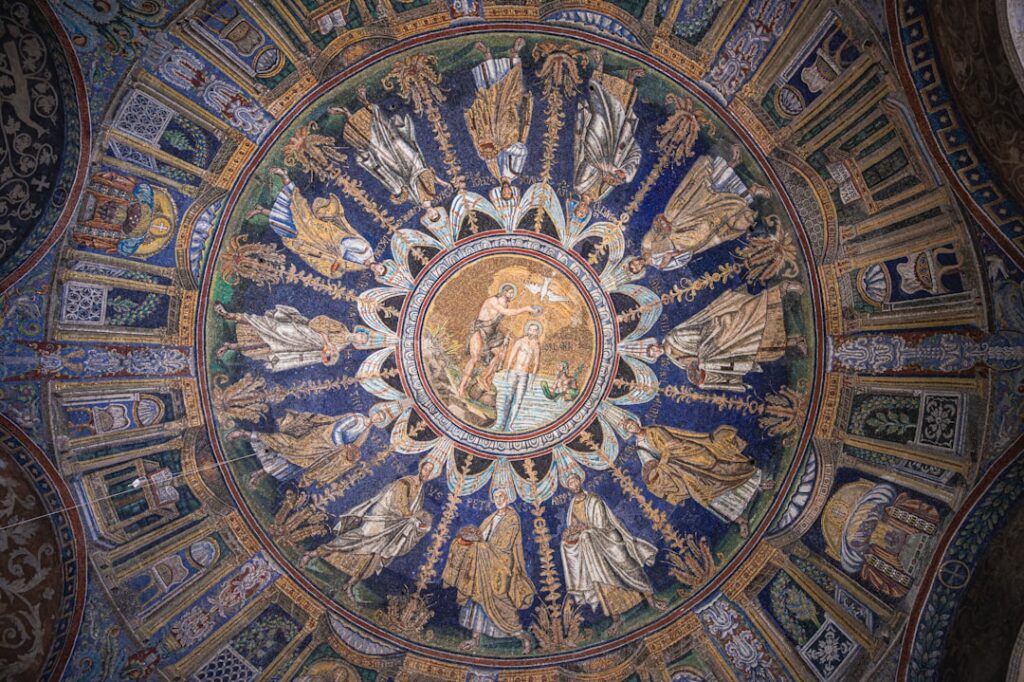
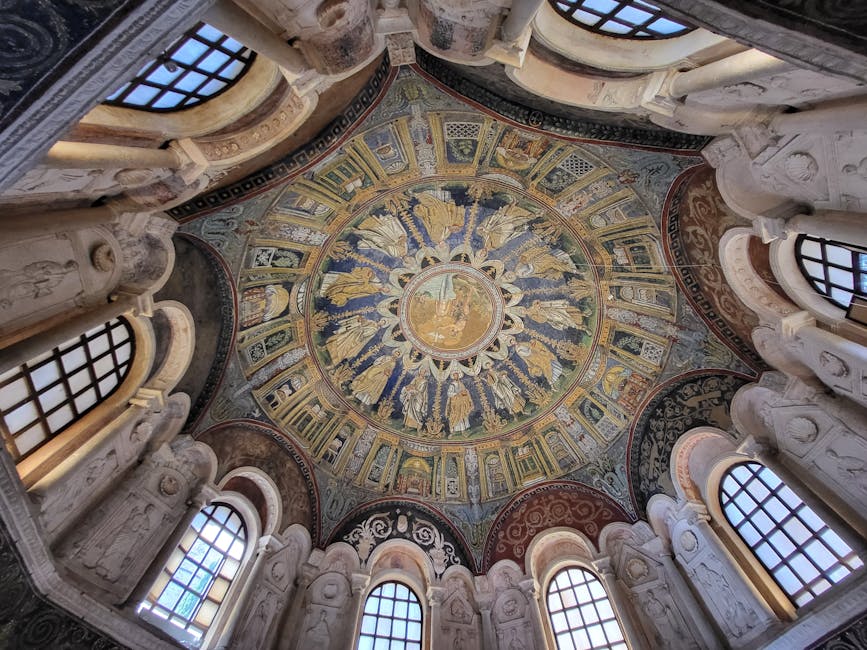
The Battistero Neoniano, often called the Orthodox Baptistery, stands in the heart of Ravenna on the Piazza del Duomo and is one of the city’s oldest and best-preserved monuments. Address: Battistero Neoniano, Piazza del Duomo 6, 48121 Ravenna RA, Italy. The modest footprint — an octagonal plan, a central conch and a baptismal font at the center — hides a decoration with strong political intent. The dome is entirely covered by a mosaic of the youthful Christ (a youthful Pantocrator) surrounded by preparatory scenes for baptism: the rivers of Paradise, virgins and apostles — a celestial cortege that places the baptized person within a salvific cosmology.
The political reading here is twofold: on one hand, the imagery asserts continuity with Byzantine imperial models — Christ as sovereign surrounded by the heavenly court — and on the other, the rite itself (entry into the Church) is presented as adhesion to a specific theological-political order. In a context where Arian Gothic kings had their own baptistery, the Neoniano version presents itself as the « victory » of public orthodoxy, a visual argument aimed at stabilizing the local community under an officially recognized dogma.
Opening hours and prices (check before you go): Battistero Neoniano — Typical hours: daily from 9:30 AM to 6:00 PM (seasonal variations). Indicative prices: solo entry ~€3–€5; often included in Ravenna’s combined monuments ticket (~€9–€12). Practical tips: visit in the morning to avoid crowds and to catch the low light skimming the mosaic (ideal for photography without flash). Respect conservation rules: no flash, no tripods, keep voices low and wear quiet shoes if you’re with a group.
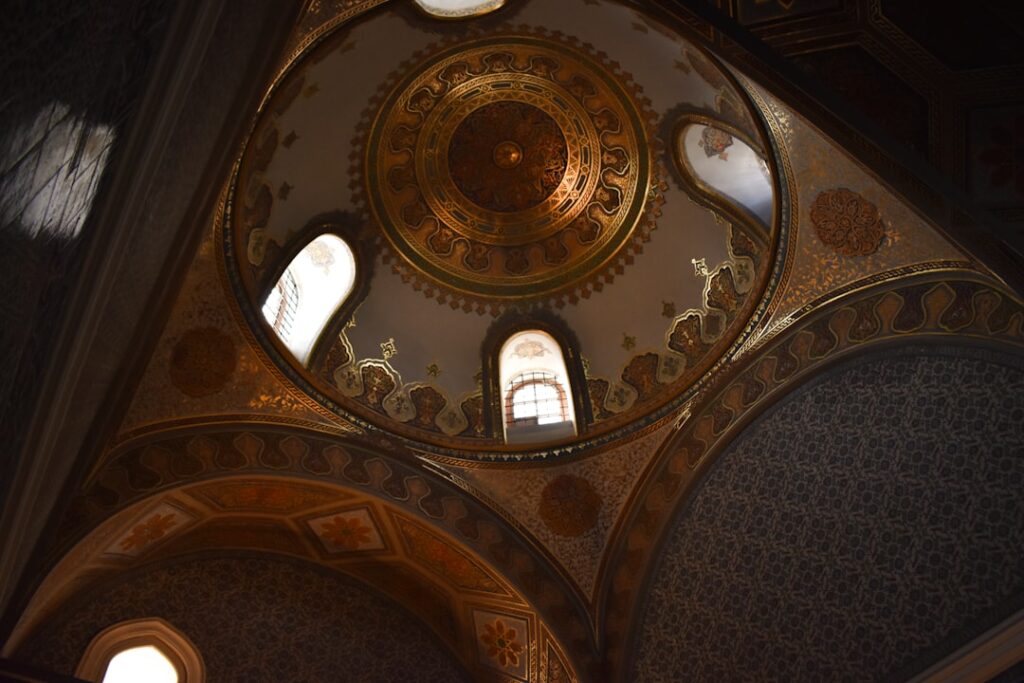
The Battistero degli Ariani: architecture, mosaics and Gothic assertion
The Battistero degli Ariani, sometimes called the Arian Baptistery, was associated with the Arian community and the Ostrogothic rulers. Address: Battistero degli Ariani, Via Galla Placidia 3, 48121 Ravenna RA, Italy. Built under Gothic rule and often located close to the Basilica of Sant’Apollinare Nuovo (the former Arian basilica), it reflects a distinct liturgy and theology. Inside, the mosaic decoration is, in some registers, more restrained but no less intentional: it emphasizes aspects of Christ and baptism that resonated with the Arian confessional identity.
Politically, the Arian baptistery played the reverse role of the Neoniano: it offered a gathering and legitimizing space for the Gothic non-Nicene elite. Where orthodoxy spoke a Byzantine visual language, the Goths — while borrowing local artistic techniques — proposed theological and stylistic variations to defend their vision of power and community. Keeping a separate baptistery expressed the desire to maintain a distinct ritual elite, and therefore a degree of political autonomy within a city contested by different actors.
Opening hours and prices (check before you go): Battistero degli Ariani — Typical hours: daily from 9:00 AM to 5:00 PM (may vary with season and restorations). Indicative price: often included in Ravenna’s combined monuments ticket (~€9–€12); single tickets may cost around €3–€6. Practical tips: the interior light is dimmer, which brings out the ochres and blues of the mosaics; use a bright lens if you’re photographing from the perimeter of the baptismal font. Respect signs and closed areas to preserve the ancient floors.
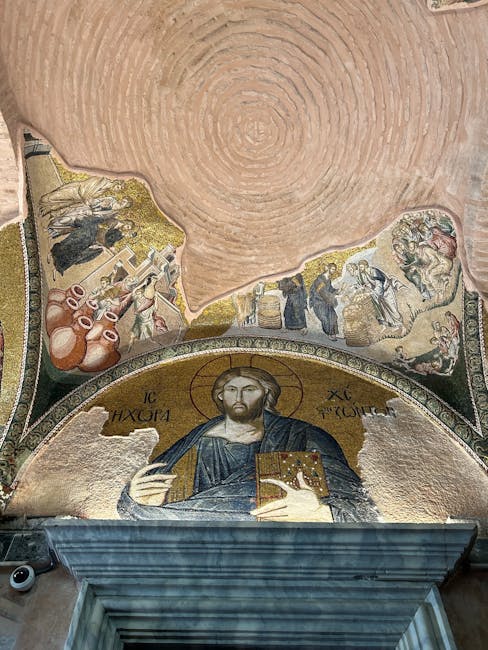
Iconographic comparison: how mosaics tell political stories
Comparing the two baptisteries is revealing: the Battistero Neoniano favors a celestial iconography, the Christ surrounded by an angelic retinue and allegories, while the Battistero degli Ariani presents sometimes more pared-down narratives focused on doctrinal themes. The choice of scenes, the placement of figures and even the colors used work together to create a narrative of authority. In one, the emphasis is on divine kingship and imperial continuity; in the other, depictions highlight the relationship between Christ, the baptizer and the believing community, sometimes with gestures and expressions that signal divergent theological lines.
From a political perspective these differences are not neutral: they function like primers of visual citizenship. Who is placed at the center? Who is surrounded by a heavenly court? Who is absent? These are answers to legitimacy questions. The city’s ecclesiastical bodies, governors and kings used these decorations to « instruct » a largely illiterate population, turning theological concepts into easy-to-read, memorable images. Thus the mosaic becomes political pedagogy.
Practical tips for visiting: prepare, get around and respect the site
Getting to Ravenna is straightforward: regular trains connect the city with Bologna, Rimini and the Adriatic coast. Once there, most monuments are clustered in the historic center, easily reached on foot. Here’s practical information to organize your baptistery visits:
- Battistero Neoniano address: Piazza del Duomo 6, 48121 Ravenna RA, Italy.
- Battistero degli Ariani address: Via Galla Placidia 3, 48121 Ravenna RA, Italy.
- General opening hours: the baptisteries typically open between 9:00 and 9:30 AM and close between 5:00 and 6:30 PM depending on the season; the combined monuments ticket gives flexible access. Check schedules on Ravenna Turismo’s official site or at the tourist office in town (Piazza del Popolo).
- Prices: single tickets roughly €3–€6; combined ticket for several monuments (San Vitale, Mausoleo di Galla Placidia, Battistero Neoniano, Battistero degli Ariani, etc.) about €9–€12. Students and seniors may be eligible for reductions; some temporary exhibitions may charge extra.
- Visitor advice: favor the morning for the light on the Neoniano dome; avoid flash and tripods; wear quiet shoes — the site is sacred and fragile; respect barriers and do not touch the mosaics.
- Photography: flash is often prohibited; follow posted rules. To capture details, use a short focal length and stable posture, or take close-ups from authorized areas.
- Local transport: taxis and city buses are available, but the center is best explored on foot. If you arrive by car, several peripheral car parks are available, such as Parcheggio Terminal Bus/Piazza Kennedy (European coordinates).
Suggested route in Ravenna: combine art, history and tasting local food
To fully grasp the political message of the baptisteries, dedicate a morning to Byzantine monuments and an afternoon to wandering the streets and sampling local cuisine. Sample itinerary:
- Morning: start at the Battistero Neoniano (Piazza del Duomo 6). Then head to the Basilica of San Vitale (Via San Vitale 17, 48121 Ravenna RA) to admire the imperial mosaics. A short walk away is the Mausoleo di Galla Placidia (Via San Vitale 16).
- Midday: lunch break in a local trattoria; try Romagna specialties like piadina romagnola, paired with a glass of Sangiovese or a local white.
- Afternoon: visit the Battistero degli Ariani (Via Galla Placidia 3) and then the Basilica of Sant’Apollinare Nuovo (Via di Roma 2, 48121 Ravenna RA) to complete your understanding of Arian and Nicene rites.
- Evening: stroll along the ancient port and dine in the centro storico neighborhood.
Conservation, heritage and contemporary challenges
Protecting these small buildings means preserving a political and religious archive. Recent restorations have revealed successive intervention layers — medieval retouches, modern reconstructions, salt deposits from humidity. Contemporary challenges also concern tourism management: how to welcome hundreds of thousands of visitors without sacrificing the mosaics’ integrity? Local institutions (Soprintendenza Archeologia Belle Arti e Paesaggio per le province di Ravenna, Forlì-Cesena e Rimini) work with international labs to stabilize tesserae and regulate lighting and indoor climate.
The political narrative of the past needs responsible transmission. Today explanatory panels and audio guides tend to contextualize theological conflicts as power struggles rather than abstract doctrinal disputes. Modern visitors can thus appreciate how sacred art served human ambitions — royal, ecclesiastical and civic — and reflect on how symbols still shape societies today.
Conclusion — Between water, tesserae and thrones: the political message of baptism
The Two-Rite Baptistery in Ravenna brilliantly demonstrates how a fundamental rite — baptism — was turned into a soft power tool for political legitimation. By placing the two buildings side by side, the modern observer reads a story of rivalries, conquests, alliances and exclusions. The Battistero Neoniano, with its celestial dome, proclaims an orthodoxy backed by imperial and urban networks; the Battistero degli Ariani shows that the Goths, despite being labeled « barbarians » in some sources, also sought to build a coherent and lasting liturgy and image of power. Together these monuments prove that sacred art is never neutral: it is a political language, a visibility stage where the individual’s place in the city was negotiated.
Visiting Ravenna, and especially these baptisteries, puts you at the crossroads where theology and geopolitics meet. It’s listening to a mosaic story — fragmented, colorful, resilient — that still speaks to us about power. For the traveler, historian or art lover, the lesson is double: admire the technical beauty of the mosaics while reading their political message. And keep the practical tips shared here — hours, addresses, prices and conservation rules — in mind so your visit is respectful and rewarding. Ravenna awaits with its golden tesserae, silent domes and stories of authority turned into eternal images.