





Introduction: Diving into Symbol — the Battistero degli Ortodossi in Ravenna
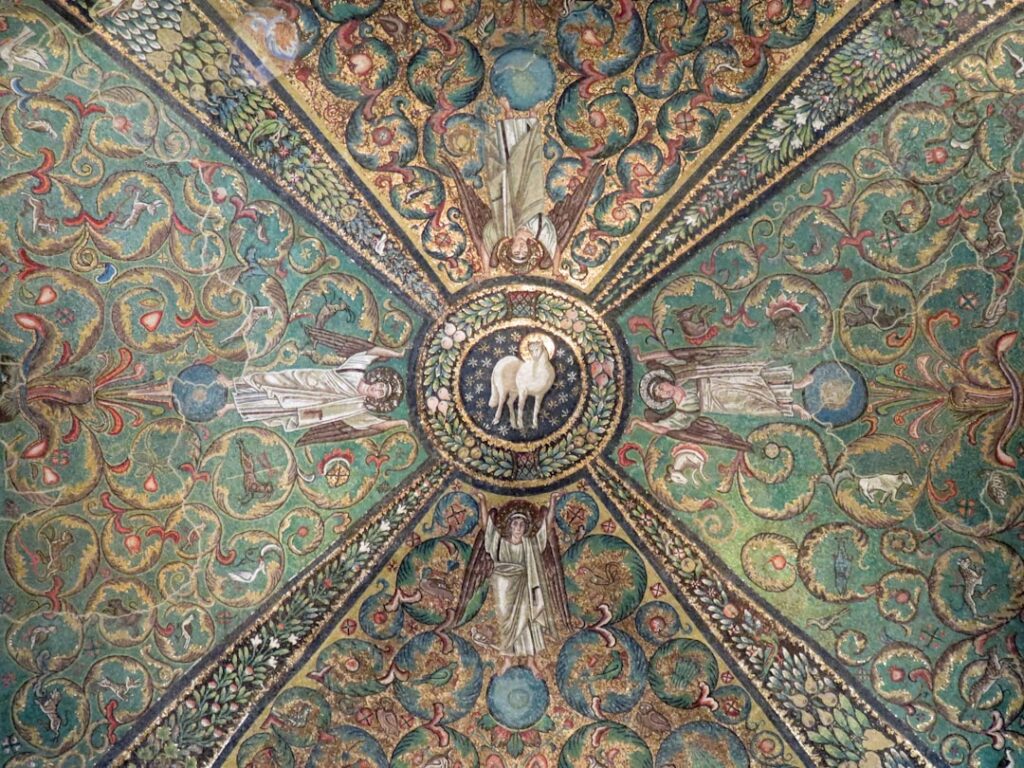
In the heart of Ravenna, a city that reads like an open-air museum where late Antiquity rubs shoulders with the Middle Ages, the Battistero degli Ortodossi (often called the Neoniano Baptistery or the Orthodox Baptistery) holds a special place among the city’s Byzantine treasures. This modest octagonal building is small in scale but exuberant in decoration — a concentrated showcase of techniques, beliefs and images that have endured for centuries. Stepping up to the baptistery is like opening a box of images: the dome dazzles with gold and colored tesserae, and the motifs converse with one another, telling a theological and liturgical story that once served as a visual catechism for worshippers.
In this article we’ll explore the meaning and symbolism behind the motifs of the Battistero degli Ortodossi, breaking down its elements: the central scene of Christ’s baptism, the apostles in procession, the allegorical figures of the river, the scrolling foliage and the geometric borders that shape the space. We’ll also look at how these images functioned in the baptismal ritual and how they were read by a multilingual, multicultural population — Ravenna being a crossroads between the Western Roman world, Byzantine East and various Germanic peoples.
Beyond iconography, visiting the baptistery is a sensory experience: the warmth of gold catching the light, the way the small resonant room amplifies a single voice, the intimacy offered by a dome above a sacred font. You’ll find practical details here too — addresses, opening times, ticket prices — plus tips to make the most of your visit (best times to avoid crowds, the best angles for photos, short readings to check before you go). Finally, we’ll place the Battistero degli Ortodossi within the wider circuit of Ravenna’s Byzantine sites (Basilica of San Vitale, Mausoleum of Galla Placidia, Arian Baptistery, Basilica of Sant’Apollinare Nuovo) so your visit becomes a coherent reading of Byzantine art and theology.
Whether you’re an iconography enthusiast, an amateur photographer, a cultural pilgrim or a curious visitor, this guide will help you decode the motifs and appreciate the rich symbolism that made the Battistero degli Ortodossi so precious to generations of worshippers and pilgrims. Let’s take a careful, image-by-image, symbol-by-symbol tour to understand why these mosaics still fascinate and move us today.
History and Context: the Site, the Era and the Workshop
The Battistero degli Ortodossi stands in Ravenna’s medieval and early-Christian core, close to the Duomo and several other famous Byzantine monuments. Official address: Battistero degli Ortodossi (Battistero Neoniano), Piazza Duomo, 1, 48121 Ravenna RA, Italy. Its proximity to the Duomo and the Museo Arcivescovile highlights its liturgical role: it was not isolated but integrated into the cathedral’s ecclesiastical complex. The building is traditionally dated to the 5th century (late 5th or early 6th century) — a transitional period when Ravenna was an important administrative and cultural center, first under the Western Roman Empire and later the seat of Byzantine power in Italy.
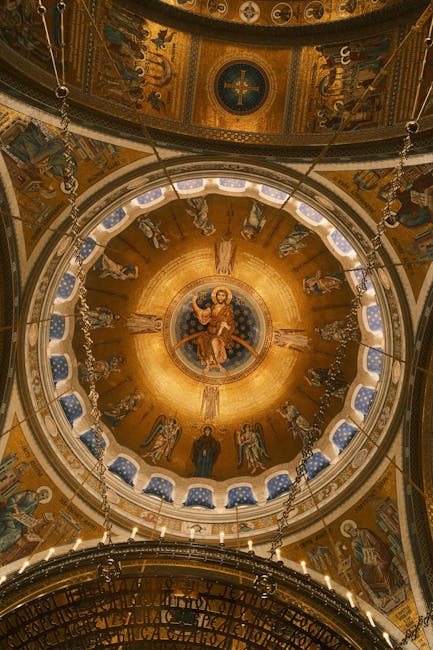
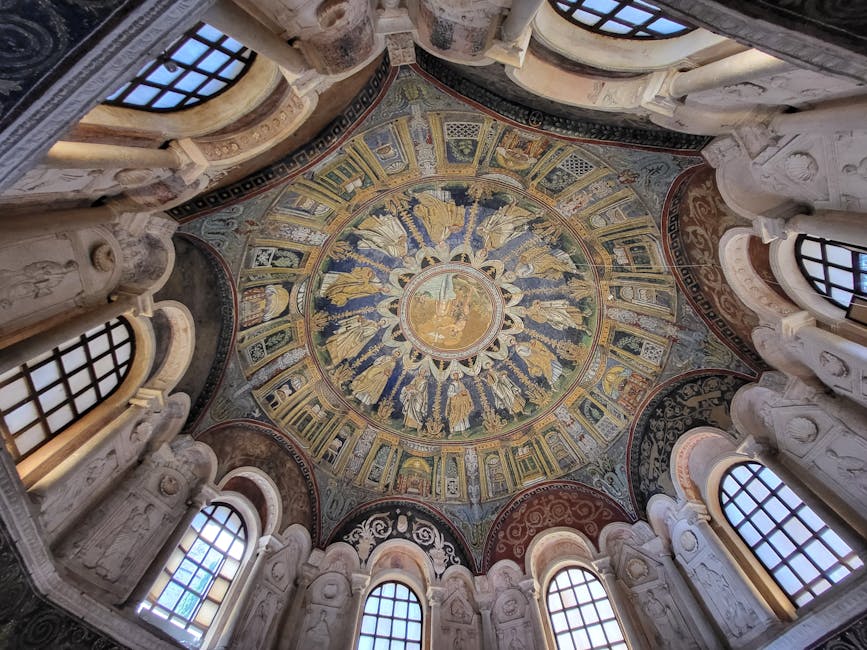
The baptistery’s octagonal plan refers to the symbolic meaning of the number eight in Christian liturgy (the « eighth day » signifying the newness of Resurrection and baptism). The inner dome is crowned by an iconic mosaic: at the center, Christ at the moment of baptism, surrounded by a chorus of apostles. The tesserae — small cubes of colored glass and gold — reveal the craftsmanship of Ravenna’s workshops, influenced by eastern models. Scholars believe the workshop that produced the mosaic blended local traditions with Byzantine canons imported from the East, which explains the pictorial quality and the finesse of the gestures depicted.
Historically, Ravenna was already a hub where artists and materials converged from across the Mediterranean when the baptistery was made. Tesserae were sometimes imported (Venice is often cited) or made locally with eastern-style glass; the imagery incorporates precise theological references and the layout of motifs follows a didactic logic: to teach, persuade and initiate. Understanding the history and setting of the Battistero degli Ortodossi helps explain why its scenes are narratively simple yet sophisticated in execution.
Iconographic Reading: Christ’s Baptism and the Apostolic Procession
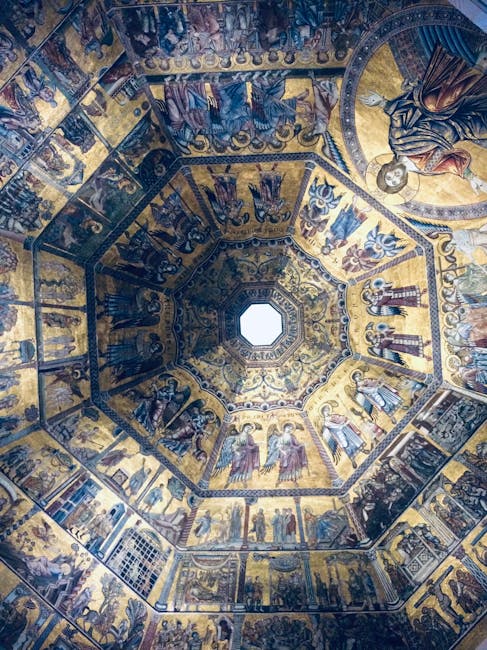
The most striking mosaic in the Battistero degli Ortodossi is undoubtedly the dome scene of Christ’s baptism. At the center, Christ (often shown wearing a loincloth or simple garment depending on interpretation) stands in the waters of the Jordan while John the Baptist performs the rite. Above them, the Spirit is sometimes depicted as a dove descending onto Christ’s head, and the heavens part beyond. This moment crystallizes the theology of baptism: purification, initiation and the coming into new life in God.
Surrounding the central scene, a frieze on the dome shows the apostles walking, usually arranged in two groups heading toward Christ. Each apostle is portrayed with an individualized face, sometimes holding books or scrolls — symbols of apostolic teaching — forming a solemn procession. This depiction is more than a simple narrative: it signals that the whole Church (the apostles as collective figures) witnesses and guarantees the sacrament of baptism. The apostles form a protective ring around the central point — baptism as the source of ecclesial identity.
Another recurring motif is the personification of the Jordan River — sometimes rendered as a bearded man or by flowing strands of water — along with fish and aquatic plants. The river is not merely a topographical detail; it symbolizes the division between the old and the new world, between sinful life and life reborn through baptism. Fish, often visible in the lower parts of the compositions, refer to the Christian Ichthys symbol, a reminder of Christian identity forged in baptismal waters.
Stylistically, the composition mixes naturalism (the gestures of baptism, the folds of garments) with abstraction (fields of gold, stylized features), a hallmark of early Byzantine art that aims to convey sacramental reality rather than provide a naturalistic reconstruction. Carefully observing these motifs — hand positions, the direction of gazes, ritual gestures — allows you to read the mosaic’s theology: baptism as passage, the Church as the community inheriting the apostolic tradition, and Christ as the regenerating center.
Ornaments and Peripheral Motifs: Scrolls, Geometry and Symbolic Animals
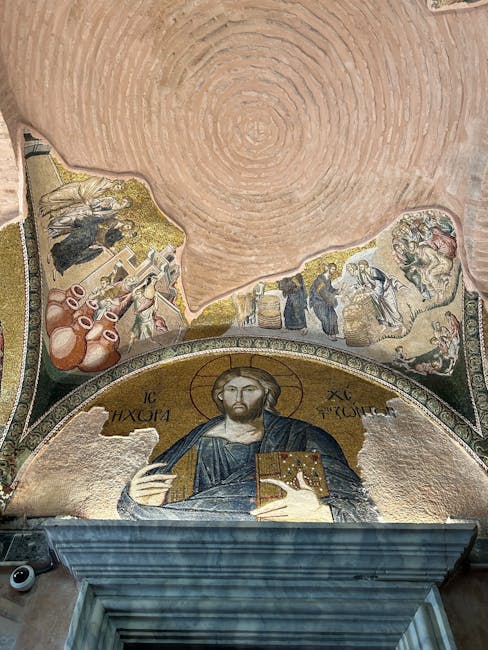
Beyond the central scene, the Battistero degli Ortodossi is filled with details that at first glance may seem purely decorative but are deeply meaningful. The scrolling vegetal motifs, often stylized into symmetrical spirals, symbolize eternal life and the paradisal renewal achieved through the sacrament. These arabesques frame the narrative scenes and create a visual continuity that directs the eye toward the sacred center.
Geometry plays a major role: chevron borders, diamonds and interlaced patterns enclose the scenes and recall the cosmic order restored by God. The use of symmetry and repetitive motifs serves a liturgical and spiritual function: formal harmony expresses the peace and perfection of the divine kingdom. Within the small interior architecture, these patterns also guide the worshipper’s visual circulation, reinforcing the immersive experience of the baptismal rite.
The symbolic bestiary is present too: doves, fish, waterfowl and sometimes mythical animals appear in the borders. The dove, in particular, is an obvious symbol of the Holy Spirit in the baptism scene; fish recall the Ichthys symbol as a testimony of Christian faith; some stylized birds point to resurrection and the soul’s ascent. Even rarer hybrid or zoomorphic creatures can be read as echoes of biblical or apocryphal themes, introduced into a visual language meant to be accessible to the people.
Colors speak their own language: the dome’s gold proclaims the presence of the divine and crafts an out-of-time space, while the blues and greens of water and vegetation emphasize life and purification. Paying attention to the palette lets you hear the theological score these motifs perform: gold for transcendence, blues and greens for life, reds for passion or sovereignty in certain contexts. Understanding these ornaments is to recognize that every motif, however discreet, takes part in the baptistery’s visual catechesis.
Visitor Practicalities: Opening Hours, Tickets and How to Make the Most of It
Before you head to the Battistero degli Ortodossi, here are the practical details to optimize your visit. Address: Battistero degli Ortodossi (Battistero Neoniano), Piazza Duomo, 1, 48121 Ravenna RA, Italy. Typical opening hours (check for seasonal changes and special closures): usually open from 9:00 AM to 5:30 PM in low season and until 7:00 PM in high season; closed on certain holidays or during liturgical events. Indicative ticket prices: €2.50 for standalone access to the baptistery; often included in the Ravenna Tourist Pass or the combined ticket « Museo Arcivescovile e Battistero Neoniano » for around €4.00–€6.00; combined passes that include multiple monuments (San Vitale, Mausoleum of Galla Placidia, Arian Baptistery) may range from €8–€15 depending on the package.
Practical tips for your visit:
- Go in the morning: the dome catches natural light best in the morning, and crowds are usually lighter between 9 and 11 AM. Low-angle light brings out the gold and the tesserae’s shimmer.
- Tickets: if you plan to combine several Ravenna sites, look into the Ravenna Pass or combined tickets at the main ticket office (Musei Civici). Smaller monuments sometimes have separate ticket booths; keep your ticket handy in case of checks.
- Photography: the space is tight; a light wide-angle lens is ideal. Follow signage (flash is often prohibited) to help preserve the mosaics.
- How long to stay: allow 20–40 minutes for a focused visit. If you want audio guides or a guided tour, plan for about an hour.
- Accessibility: access can be narrow and include a few steps; contact the Museo Arcivescovile for specific accessibility needs.
- Nearby visits: take advantage of the Duomo di Ravenna (Piazza Duomo), the Museo Arcivescovile (Via della Cattedrale, 2, 48121 Ravenna RA) and the Battistero degli Ariani to build a themed itinerary on baptismal iconography.
For families: explaining the concept of baptism to children through images (dove, water, fish) helps spark their interest. For art lovers: take time to study the tesserae in daylight and note the direction of gazes and gestures — these are key narrative clues. Always check current opening hours on Ravenna’s official site or with the Ravenna Tourist Office before you go; times and prices can change with the tourist season and cultural events.
Suggested Route: Continue the Motif Trail Around Ravenna
The Battistero degli Ortodossi is part of a network of Byzantine monuments that answer one another visually. To extend your reading of the motifs and spot iconographic variations, here’s a compact walking itinerary you can do in half a day, with addresses and suggestions:
- Mausoleum of Galla Placidia — Via degli Ariani, 1, 48121 Ravenna RA. Indicative price: €5.00–€7.00. Hours: usually 9:00 AM–7:00 PM. This small mausoleum houses a starry sky and funerary mosaics whose symbols (lamb, cross, celestial decor) continue the themes of salvation and the afterlife.
- Basilica of San Vitale — Via degli Ariani, 10, 48121 Ravenna RA. Indicative price: €6.00–€9.00. Hours: 9:00 AM–6:00 PM. Here, imperial iconography (mosaics of Emperor Justinian and Empress Theodora) converses with the ecclesiastical symbols seen in the baptistery.
- Arian Baptistery (Battistero degli Ariani) — Via di Roma, 4, 48121 Ravenna RA. Indicative price: €3.00–€5.00. Hours: 9:00 AM–5:00 PM. Comparing the two baptisteries (Arian and Orthodox) is fascinating for understanding doctrinal and stylistic differences of the period.
- Basilica of Sant’Apollinare Nuovo — Via di Roma, 53, 48121 Ravenna RA. Indicative price: €5.00–€8.00. Hours: 9:00 AM–5:30 PM. The apostolic processions and narrative cycles here provide a complementary repertoire to the baptistery’s motifs.
Route tip: start at the Battistero degli Ortodossi in the morning, then move to the Duomo and the Museo Arcivescovile (to understand the episcopal context), followed by the Mausoleum of Galla Placidia and San Vitale. Adjust the sequence according to opening hours and crowd levels.
Conservation and Challenges: Preserving a Story Over Time
The mosaics of the Battistero degli Ortodossi have endured nearly fifteen centuries: climate effects, human interventions and visitor habits have all left their mark. Ravenna’s conservation teams, working with European institutes, focus on stabilizing tesserae and mitigating risks from humidity and vibrations. Restorations aim to respect the material and aesthetic authenticity of the works: cleaning tesserae, consolidating supports and installing microclimate control systems.
A major challenge is balancing public access with scientific preservation. Allowing visitors to see these spaces spreads knowledge and builds interest in heritage, but heavy footfall can accelerate deterioration if visitor numbers and environmental conditions are not managed. Ravenna’s museum policy therefore combines quotas, guided circuits and awareness campaigns for visitors.
Conscious visitors can help by following a few simple rules: respect barriers, avoid flash photography and don’t touch surfaces. On an institutional level, the good news is that Ravenna has an engaged network of museums, universities and foundations that support ongoing research and conservation. By following basic guidelines, every visitor helps preserve the mosaic story the Battistero degli Ortodossi tells.
Conclusion: Why These Motifs Still Speak to Us
The Battistero degli Ortodossi in Ravenna is more than an ancient work of art: it’s a meaning-making machine, a space where image and ritual meet to give shape to a fundamental human experience — being born into a new spiritual life. The dome’s motifs and the surrounding friezes express a theology of passage, community and resurrection. They connect the faithful to a scriptural and liturgical tradition and invite us today to reflect on the symbols that shape our lives.
Throughout this guided tour we highlighted the key elements: the central depiction of Christ’s baptism and the descent of the Spirit, the apostles’ procession as an image of the Church, scrolling and geometric motifs as metaphors for eternal life, and the symbolic bestiary as memory of a religious culture. We also explained how to read these signs, where to stand for the best view, and how to extend the experience by visiting other Ravenna monuments.
Visiting the Battistero degli Ortodossi takes patience and attention: take the time to look, interpret and feel the theological density embedded in the tesserae. It’s an experience that rewards close observation with the discovery of intention — the desire to teach and to move through images. Ultimately this small building reminds us that sacred art is a living language; it crosses centuries to still speak to our modern sensibilities and teaches us to read the world in signs. Whether it’s your first visit to Ravenna or you’re deepening your knowledge of Byzantine mosaics, the Battistero degli Ortodossi remains an essential, intimate and deeply meaningful stop.
Before you leave, remember: check current opening times and ticket prices (they may vary by season), follow conservation rules and, if possible, pair your visit with San Vitale and the Mausoleum of Galla Placidia for a fuller reading of Ravenna’s iconography. The baptistery’s motifs will stay with you long after you step out from under the gilded dome.