





Introduction: Faces and Icons — discovering Ravenna’s Byzantine mosaics
Ravenna is, for anyone fascinated by Byzantine art and the visual memory of late Antiquity, an open-air museum where stone and glass tell stories of faith, power and aesthetics. Between the 6th and 7th centuries this Adriatic town became a major political and cultural crossroads: capital of the Western Roman Empire under Byzantine administration and later home to influential bishops. The result is an astonishing density of mosaics whose faces and icons form a sacred, human gallery — imperial figures, martyrs, angels, Christ Pantocrator, and saints whose gazes seem to cross the centuries.
This article is meant to be a practical, immersive guide: it doesn’t stop at admiring the golden shimmer of tesserae, but tells you where to go, how to get there, how much it costs, opening hours, and how to read these images. I will describe in detail Ravenna’s main mosaic sites — Basilica di San Vitale, Mausoleo di Galla Placidia, Battistero Neoniano (Orthodox Baptistery), Basilica di Sant’Apollinare Nuovo, Basilica di Sant’Apollinare in Classe — giving exact addresses, prices in euros and local tips to make the most of your visit.
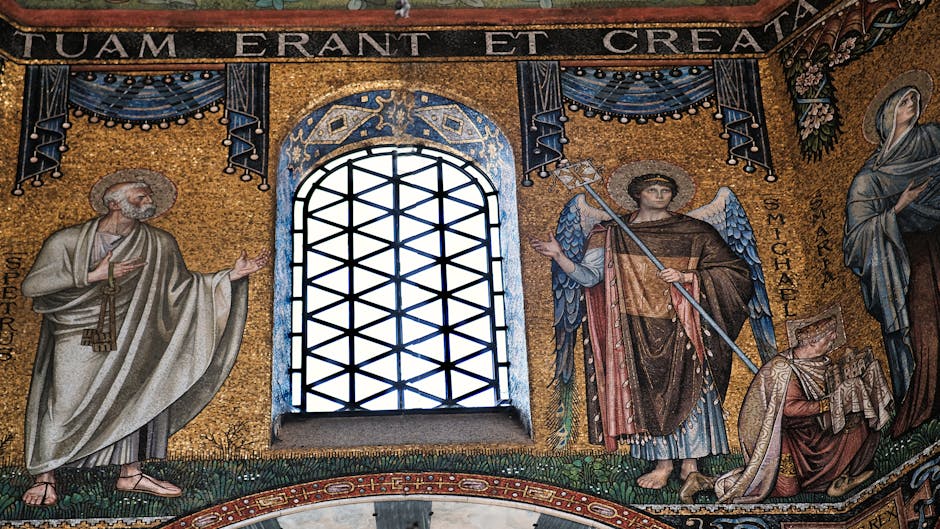
Ravenna’s mosaics stand out for their intense colors and distinctive facial treatment: stylized features, wide eyes, long noses, frontal or three-quarter gazes, and restrained mouths. But behind this apparent stillness each face carries a political and theological message. Icons are not modern psychological portraits; they embody authority, sanctity and divine continuity. Understanding that shifts the visit: you stop merely “looking” and begin to “read.” This guide will give you the keys to decode those signs — pose, background color, hierarchy of figures, presence of attributes — and to spot details often missed at first glance, like hand gestures, liturgical details in clothing, or small Latin and Greek inscriptions.
I’ll also share logistical advice — best times of day to visit, photography rules, accessibility, combination tickets, and crowd-busting tips — plus practical recommendations (where to eat, how to get around on foot or by bike, and how to extend the experience in local museums). Visual markers 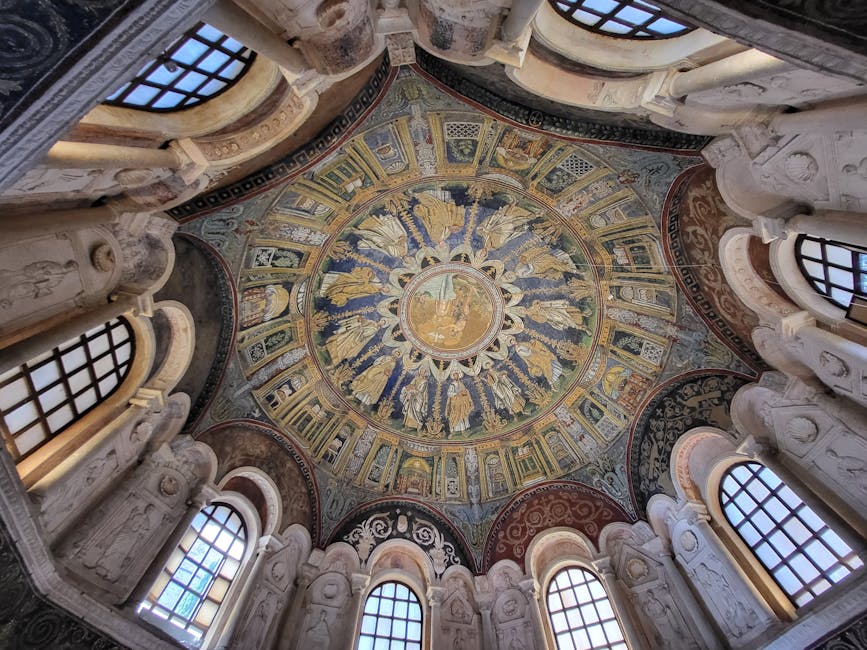 will punctuate the text to give you photo ideas and prepare your eye. As you move through the sections, you’ll discover not just the places but how to experience mosaic art: slow approach, close observation, and a return to Ravenna’s quiet historic streets.
Basilica di San Vitale and Mausoleo di Galla Placidia: the high point of mosaic portraiture
Basilica di San Vitale and the Mausoleo di Galla Placidia form an unmissable duo, neighbors in the historic center. The Basilica di San Vitale is located at Via San Vitale, 5, 48121 Ravenna RA, Italy. Hours: generally 09:00–19:00 (last admission 18:30); closed on some public holidays — check the notices at the entrance. Entrance fee: €10.00 for access to the basilica alone. The Mausoleo di Galla Placidia is at roughly the same address (Via San Vitale, 5, 48121 Ravenna RA, Italy) and is often sold as a combined ticket; indicative price for the mausoleum alone: €6.00. A “cumulative ticket” for Ravenna’s UNESCO monuments may be offered around €13.00–€15.00 depending on the season.
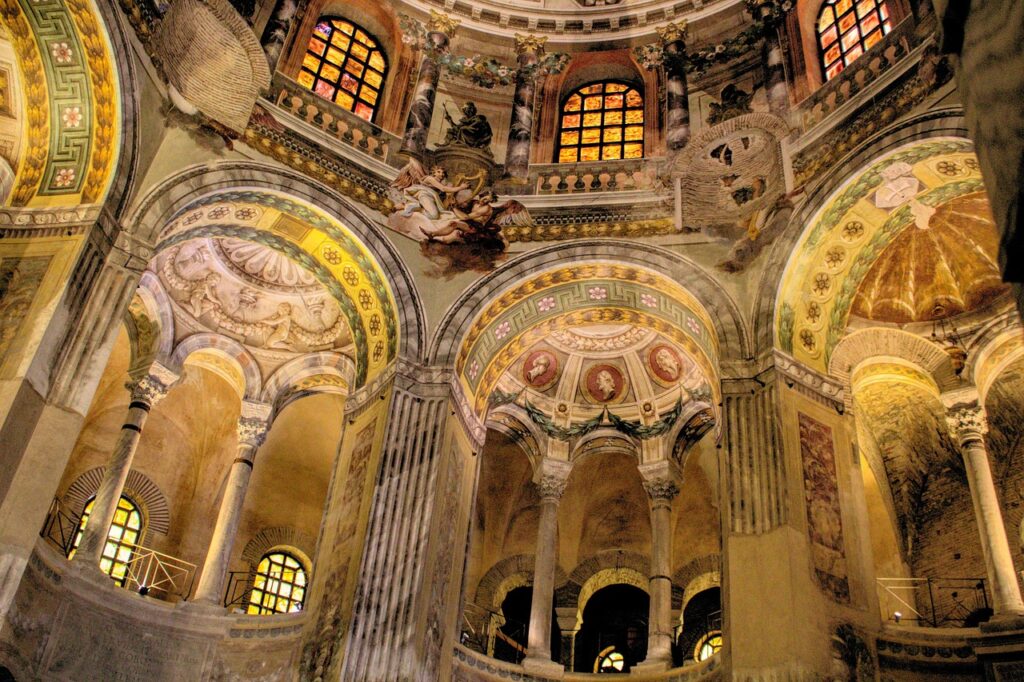
The basilica impresses with its octagonal plan opening onto an apse richly covered in mosaics: the iconography blends biblical scenes, portraits of emperors (notably Justinian and his imperial court on a frieze), and figures of bishops. Look for the portrayals of Justinian and Theodora in procession — these official portraits mix political homage with sacralization: the faces are not highly naturalistic but possess a strong presence thanks to frontal gazes and golden backgrounds.
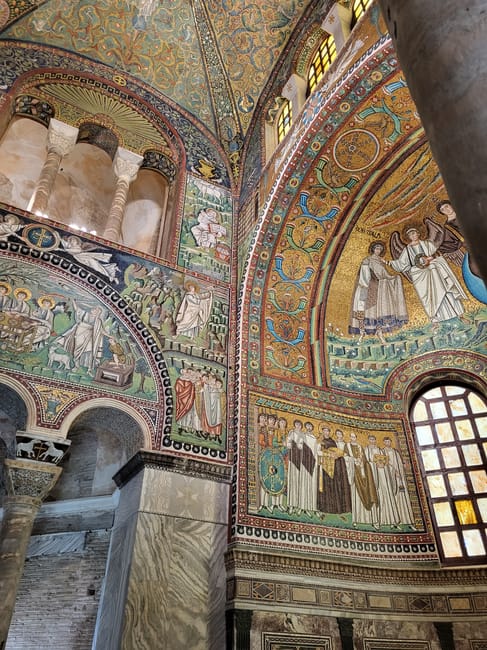
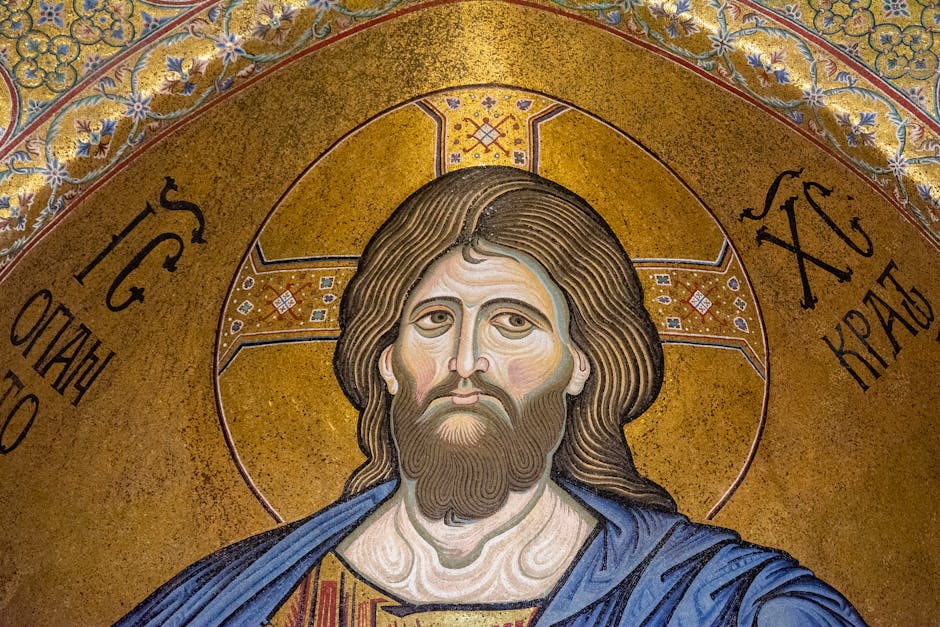
The Mausoleo di Galla Placidia is a small funerary chapel whose interior is entirely covered in blue and gold mosaics, featuring one of the most famous images of Christ in majesty (including scenes of Christ as the Good Shepherd and Christ Pantocrator in certain vaults) plus motifs of wheat sheaves and doves. The mausoleum’s mosaics are exceptionally refined: the tesserae are small, the rendering of faces solemn, almost hieratic, and the overall effect is that of a tactile cosmos. The mausoleum is often calmer than the basilica, making it an ideal spot for attentive observation and slow reading of the icons.
Practical tips: arrive early to avoid crowds and the harsh reflected light on the gilded walls. Photography is generally allowed without flash; respect barrier zones and do not touch the mosaics. Floors can be slippery near entrances — wear sturdy shoes. If you’re short on time, prioritize the mausoleum for its concentrated visual intensity, then the basilica for historical narrative and the series of imperial portraits.
Battistero Neoniano and the story of baptismal faces
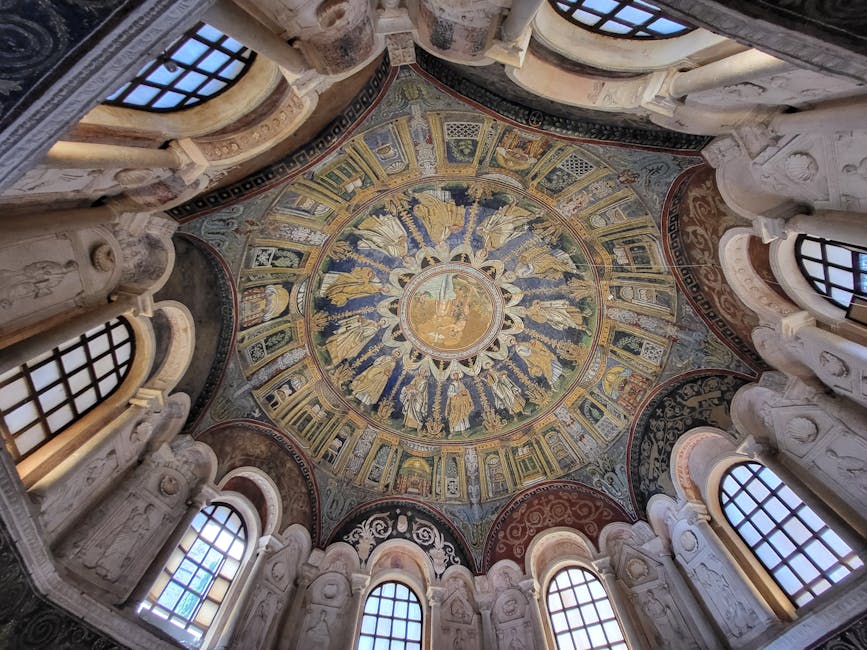
The Battistero Neoniano (or Orthodox Baptistery) stands on Piazza del Popolo, 48121 Ravenna RA, Italy. Hours: usually 09:00–18:00; seasonal variations possible. Entrance fee: €4.00 (museum/historic building rate, subject to updates). This small square building with an octagonal apse is one of Ravenna’s oldest Christian monuments and a key place to understand how the representation of faces is tied to a specific ritual — baptism, the primary rite of Christian initiation.
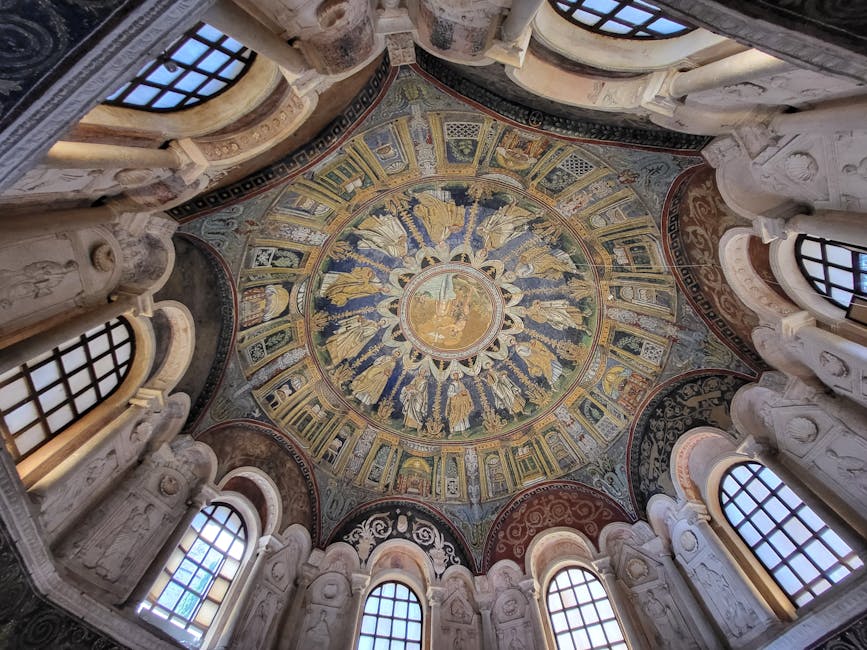
At the center of the dome, the figure of Christ — often called “Christ in Glory” — dominates the baptism of Christ by John the Baptist. The faces of the angels and surrounding figures express a theological hierarchy: Christ is frontal, immutable, and his features are made with larger tesserae contrasting with the decorative peripheral details. The converging gazes of the figures toward the baptism guide the viewer’s eye and reinforce the sacramental centrality.
The small size of the space encourages close proximity: you can almost reach the mosaics with your fingertips — but of course touching is forbidden. Artificial lighting is arranged to minimize glare and enhance the blue and gold tesserae. If you’re interested in technique, look for material variations: colored glass, gold leaf on glass, and sometimes semi-precious stones.
Local tip: combine the baptistery visit with a stroll around Piazza del Popolo and a stop at the historic café nearby for a light espresso before your morning of sightseeing. The baptistery is compact; 20 to 30 minutes are enough for a focused reading, but peak hours (late morning and early afternoon) can be busier. If you have a Ravenna Card, check for applicable discounts.
Basilica di Sant’Apollinare Nuovo and the saints’ procession
The Basilica di Sant’Apollinare Nuovo is located at Via di Roma, 56, 48121 Ravenna RA, Italy. Hours: 09:00–17:30 (times vary by season); closed during some religious ceremonies. Entrance fee: €6.00 (standard rate). This basilica is famous for its long frieze of processions of saints and martyrs, aligned like a human gallery. Here portraiture is collective: smaller, repeated faces create an effect of a sacred crowd that amplifies the idea of the triumphant Church.
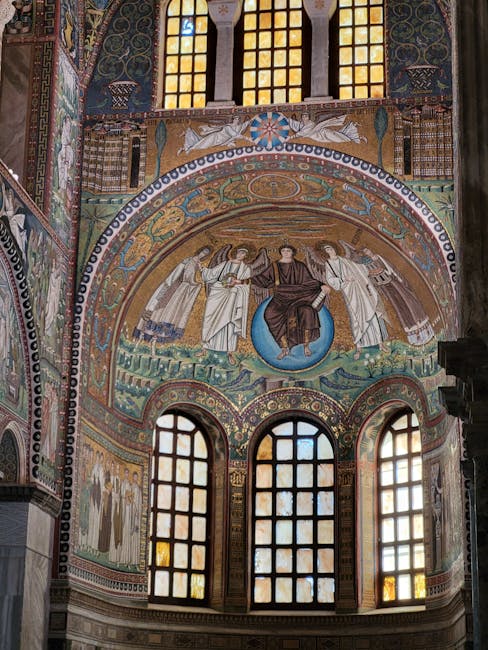
The composition shows, across many meters, figures in bust or full-length walking toward the main figure in the apse. The faces are stylized but individualized by hair color, garments, and inscriptions. You’ll want to get closer to read these small details: Latin or Greek inscriptions above the heads, attributes (palm for martyrs, book for evangelists) and liturgical gestures. The rhythmic repetition of faces produces a kind of “visual choir” that conveys the persistence of faith.
On the opposite wall, narrative scenes depict Gospel and hagiographic episodes; again, faces are designed for readability at a distance: large eyes, elongated noses, and a facial expression that fixes the believer’s gaze. The basilica also sometimes hosts temporary exhibitions and sacred music concerts, which can add an acoustic dimension to the visit.
Practical advice: the best time to enjoy the frieze is mid-afternoon, when side light makes the golden tesserae sparkle. If you’re visiting with children, give them a little observation game: spot saints holding a book, a palm or a crown. For photographers, watch for restrictions: non-flash photography is usually allowed, but avoid tripods during busy hours.
Sant’Apollinare in Classe and the dialogue between architecture and icon
The Basilica di Sant’Apollinare in Classe lies a little outside the historic center, at Via Romea Sud, 224, 48125 Classe RA, Italy. Hours: 09:00–12:30 and 15:00–18:30 (varying with season and religious services). Entrance fee: €6.00 (standard rate); some discounts for students and seniors. This large building, erected in the necropolis of Classe, is notable for an apse dominated by a large mosaic of Christ in majesty surrounded by sheep and palm trees — a powerful symbolic tableau linking the sacred to the funerary landscape.
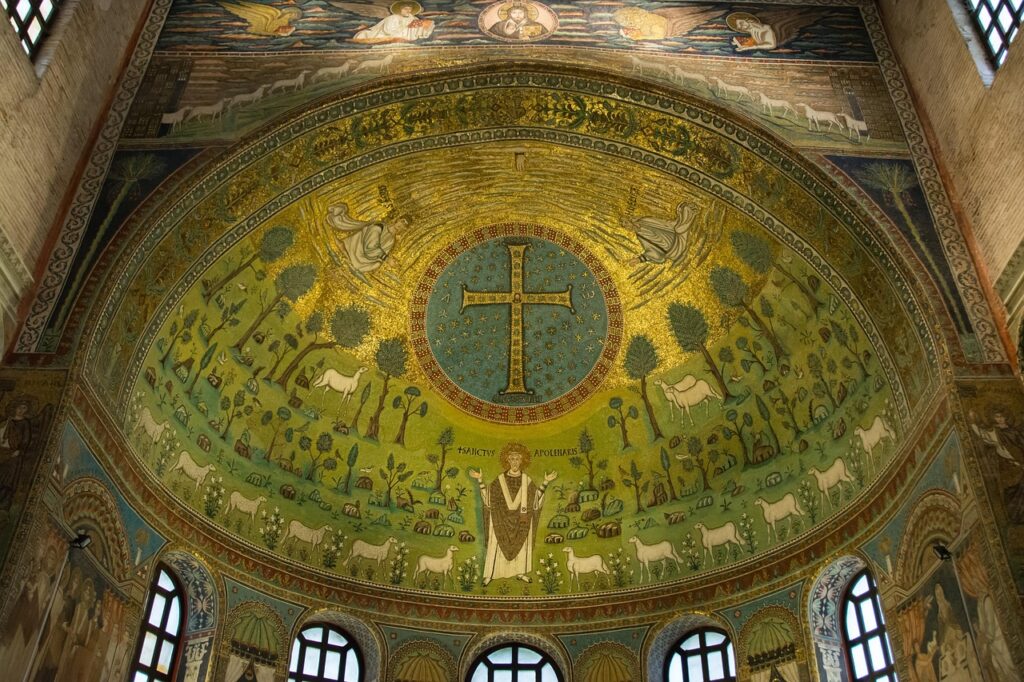
The apse mosaic at Sant’Apollinare in Classe is a masterpiece of clarity and symbolism: Christ’s face is frontal, monumental, not highly expressive but solemnly grave. Around him pastoral signs (the sheep) and vegetal motifs create an image of paradise. Unlike imperial portraits, this figuration aims at universality and liturgical identification.
The basilica’s very architecture encourages contemplation: the long, open basilica plan directs the gaze toward the apse, and the acoustics are deep. Natural light comes through high windows, highlighting mosaics differently depending on the hour. During a service, the emotional experience is heightened by chant, making the mosaic faces feel almost alive.
Logistics: Sant’Apollinare in Classe is reachable by bus from Ravenna station (local line) or by taxi (about 10–15 minutes depending on traffic). Allow 1 to 1.5 hours for the visit, especially if you want to see the exterior and the small adjoining museum. There is paid parking nearby. For photographers, non-flash photography is permitted; the lighting contrast often requires higher ISO settings without flash to capture the tesserae details high in the apse.
Museums and further reading: Museo Nazionale di Ravenna and the Domus
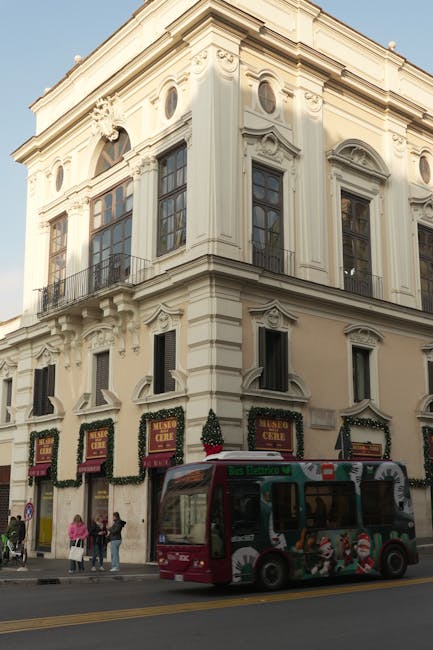
To complement your reading of the in-situ mosaics, head to the Museo Nazionale di Ravenna, located at Piazza San Francesco, 3, 48121 Ravenna RA, Italy. Hours: 09:00–19:00 (times may vary). Entrance fee: €7.00 (standard museum ticket). The museum preserves fragments, drawings and liturgical objects that help explain the techniques and the religious life of mosaicists. Labels there detail the materials (glass tesserae, gold on glass, marble) and technical gestures (cuts, inclinations and placements).
Another interesting stop is the Domus dei Tappeti di Pietra (House of the Stone Carpets), located in the center, often listed as Via di Roma / Via IV Novembre — the official entrance and hours vary with exhibitions; indicative price: €6.00. The Domus shows well-preserved floor mosaics, offering a counterpoint to monumental apse scenes by revealing decorative and secular work, sometimes adorned with faces, animals and geometric patterns.
Museum tips: plan 1 to 2 hours, and carry a map of Ravenna (useful cultural information is available at the Ufficio Turistico di Ravenna, Via di Roma 2, 48121 Ravenna RA, Italy — hours 09:00–13:00 and 15:00–18:00; free information). Museums often provide audio guides in multiple languages; they’re worth the expense to understand symbols and historical context. Buying a combined ticket can reduce the total cost if you plan to visit several sites.
Local hacks: bring a pocket magnifier to read small inscriptions or tesserae details (especially useful in museums and the Domus). Local guides offer themed tours (technical, theological, iconographic): book ahead, especially in high season. Finally, browse the specialist bookstores around Piazza del Popolo for detailed maps and mosaic reproductions — great souvenirs and tools to extend your study at home.
Conclusion: how to read the faces, extend the experience and respect the heritage
Ravenna’s Byzantine mosaics operate on many levels at once: visual, liturgical, political and technical. The faces you encounter in the basilica, the mausoleum, the baptistery and the Classe aren’t portraits in the modern sense but icons meant to assert collective truths — the permanence of faith, imperial authority or the memory of martyrs. Reading these faces requires slowing down: observe frontal presentation, how the eyes are rendered, hierarchical sizing and placement, and note the attributes that identify figures (books, palms, episcopal garments).
To extend the experience after your visit, spend time with the collections at the Museo Nazionale di Ravenna (Piazza San Francesco, 3) and flip through specialist books available in local bookstores. Join a themed guided tour to deepen technical (tessellation styles, materials) or theological aspects. If you want full immersion, attend a service in one of the churches: liturgical chant reconnects you with the original uses of these images.
Respect for the heritage: remember these works are sensitive to light, humidity and vibrations. Always follow staff instructions: no flash, no tripods, don’t cross barriers, and keep noise to a minimum. The entrance fees and prices listed in this guide are for information only (e.g. San Vitale €10.00, Mausoleo di Galla Placidia €6.00, Sant’Apollinare Nuovo €6.00, Battistero Neoniano €4.00, Sant’Apollinare in Classe €6.00, Museo Nazionale €7.00); they may change. Check official websites or the Ufficio Turistico di Ravenna before you travel.
Finally, let yourself be moved by the human reach of these images. Ravenna’s mosaics speak of men and women who tried to fix the invisible in matter. In looking at their faces you gain a better sense of how art can foster memory and transmission — and why Ravenna, a small town with quiet streets, remains a major center of Europe’s artistic memory. Take your time, respect the sites, and let each icon invite you to read a little beyond the glittering gold of the tesserae.